Welcome back to Recruiting 101, the monthly Baseball Forward series where Aaron Cunningham and Ross Hawley give direct, practical recruiting guidance for players and families.
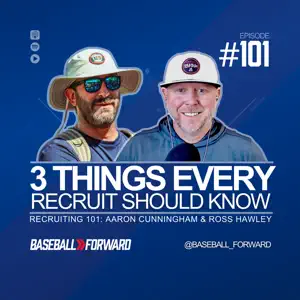
This episode answers one simple question: What do players actually need to know to navigate recruiting well right now? Aaron and Ross narrow it down to three essentials: when the process starts, how to think about your options, and what real recruiting interest looks like.
If you're catching up on the series, start with Episode 1, Episode 2, Episode 3, and Episode 4.
Watch or Listen to the Full Episode:
🎯 Key Takeaways Summary
✅ Recruiting starts later than most families think - For most players, real traction begins around junior year and often peaks during senior year.
✅ Development comes before exposure - If your body and game are not ready, chasing attention too early usually wastes time.
✅ Know your real options - The best fit is the place where you can play, develop, earn a degree, and enjoy your career.
✅ Division I is not the only good answer - JUCO, D2, D3, and NAIA can all be the right path depending on your profile and goals.
✅ Social media is a tool, not the finish line - Follows, views, and profile traffic are not the same as active recruiting.
✅ Real recruiting is personal - Calls, direct messages, coach conversations, and real relationship-building are what move the process forward.
✅ Long-term thinking matters - Make decisions based on where you want to be at 24-26, not what feels impressive at 17.
Question 1: When Does the Recruiting Process Actually Start?
The Short Answer
For most players, not nearly as early as social media makes it seem.
Aaron and Ross make the same point repeatedly in this episode: if you are doing a full-blown recruiting push well before junior year, you are probably early. Yes, there are legal contact dates and there are always a few clear-cut Division I prospects who get identified early, but that is not the reality for the overwhelming majority of players.
What Families Need to Understand
The symbolic starting point for many players is junior year.
Why? Because college programs now build rosters much closer to the present than they used to. The transfer portal, older rosters, and year-to-year roster management have changed everything. Coaches are no longer forced to make decisions two or three years in advance for most high school players.
What that means in practice:
- Freshman and sophomore years should be about development first
- The summer after sophomore year is when more players start getting meaningful eyes on them
- Senior fall is now a very active recruiting window for a large percentage of players
Ross and Aaron also make an important physical point: if you want to be recruitable later, you have to spend the early years becoming stronger, faster, and more athletic. That does not mean panic. It means use the runway correctly.
A Better Way to Think About the Timeline
Instead of asking, "How early can I start recruiting?" ask:
"What do I need to become before recruiting matters?"
That shift changes the whole process. It moves the focus back to body development, skill growth, and competitive maturity. It also keeps families from wasting energy chasing attention before a player is truly ready.
Call to action: If you're underclassmen, stop measuring progress by offers and start measuring progress by development.
✅ Action Items: Recruiting Timeline
- If you're a freshman or sophomore, prioritize strength, speed, skill work, and game performance over recruiting noise
- Use the summer after sophomore year as a checkpoint: Are you physically and competitively ready to be evaluated?
- If you're a junior or senior, understand that you are not late just because someone else committed earlier
- Build a development plan with your coaches instead of forcing an early recruiting plan
- Keep your long-term goal in view instead of chasing early validation
Question 2: How Should You Think About Your Options?
Start With Reality, Not Ego
The second big lesson from this episode is simple: know your options and be realistic.
That is not pessimism. It is strategy.
Aaron and Ross point out that the average age of Division I baseball has climbed significantly. Rosters are older. Programs have access to transfers, junior college players, and more proven options than ever. That changes how a high school player should evaluate the landscape.
What "Be Realistic" Actually Means
It means asking honest questions:
- Can I play there right now, or do I just like the logo?
- Will I actually have a path to the field?
- Is this school the right academic, social, and financial fit?
- Do I need an extra developmental step before I reach my ceiling?
This is where Aaron's JUCO point matters. For many players, junior college is not a fallback. It is a development accelerator. More reps, more practice time, and more room to physically mature can be the right answer if the long-term goal is still bigger baseball later on.
Choose the Place That Fits the Whole Picture
Ross makes a point families need to hear: just because you can play at the highest level does not automatically mean you should.
The right school is not just the most recognizable one. It is the place where:
- You can contribute
- You can keep developing
- You can build relationships
- You can earn a degree that matters after baseball
- You actually want to live and compete
If you spend four years doing all the work but rarely get on the field, that wears on players. The better path is often the one where you are trusted, developed, and given a real opportunity to impact games.
Call to action: Make your school list based on fit and opportunity, not status.
✅ Action Items: Evaluating Your Options
- Build a target list that includes multiple levels, not just Division I
- Ask a trusted coach for an honest assessment of your current level and developmental ceiling
- Research roster age and competition at schools you're considering
- Evaluate academic fit and total cost alongside baseball opportunity
- Consider JUCO, D2, D3, and NAIA as legitimate pathways, not consolation prizes
- Prioritize places where you can play, grow, and enjoy your college career
Question 3: What Does Real Recruiting Interest Look Like?
The Biggest Misunderstanding in Recruiting
This may be the most useful section in the episode.
Aaron and Ross draw a hard line between attention and recruiting.
Profile views, social media follows, and indirect buzz can feel encouraging. Sometimes they do matter. But they are not the same as a coach actively recruiting you.
The Standard to Use
If there is no personal interaction, there usually is not a recruiting relationship yet.
Real recruiting usually looks like:
- Direct communication from a coach when allowed
- Messages, calls, or meaningful follow-up
- Conversations with your high school or travel coach
- Camp interaction that leads to continued contact
- Clear next steps, not vague online activity
Ross uses a dating analogy in the episode, and the point lands: if someone never talks to you, never reaches out, and never acts on the interest, you do not have much yet.
What Social Media Is Actually For
Aaron is clear that players should absolutely use Twitter/X well. It works as a living resume. It gives coaches a quick view of your video, updates, measurables, and interests.
But the tool only matters if you use it to create real interaction.
If a coach follows you:
- Say thank you
- Express interest professionally
- Give them a reason to know who you are
- Keep playing well enough to stay relevant
If a coach views your profile, the next question should be: What's my next step?
That mindset matters. Passive families wait for signals to turn into offers. Active families use signals as prompts to communicate better.
Relationships Still Drive the Process
This episode keeps returning to one principle: baseball is still a relationship business.
That is true in recruiting, in college, and after college. The players who communicate well, handle themselves maturely, and build real trust with coaches give themselves a better chance to keep moving.
Call to action: Stop treating recruiting like a dashboard of likes and views. Treat it like a relationship-building process.
✅ Action Items: Real Recruiting Activity
- Build or clean up your Twitter/X profile so it functions as a clear recruiting resume
- When a coach follows or engages, respond professionally and express interest
- Ask after every touchpoint: "What is the next step from here?"
- Keep your high school and travel coaches informed so they can help connect dots
- Don't confuse online activity with an offer or a true recruiting relationship
- Focus on meaningful communication, not empty recruiting fluff
Question 4: If You Could Give One Piece of Advice to Your Younger Self, What Would It Be?
Aaron's answer is direct: for him, it would have been JUCO.
That answer matters because it shows how players should frame decisions. The question is not, "What sounds biggest right now?" The real question is, "What gives me the best chance to become what I want to be later?"
If your goal is professional baseball, then your path should be evaluated by how it supports your development over the next 6-8 years, not how it looks on signing day.
Ross pushes the same idea: start with the end goal. If your dream is to play the game as long as possible, then every decision should serve that long-term arc.
For some players, that will be Division I right away. For others, it will be JUCO first. For many, it will be a great fit at another four-year level where they can play immediately and keep improving.
✅ Action Items: Long-Term Thinking
- Define your real long-term goal in baseball and in life
- Evaluate every school option through the lens of development, not reputation alone
- Ask which environment gives you the best chance to become a better player in 2 years
- Make peace with taking an extra step if that step moves you closer to the right destination
- Revisit your recruiting plan every few months as your body, game, and goals evolve
📋 Episode 5 Checklist: Your Game Plan
Use this checklist to turn Episode 5 into action.
Immediate Actions (This Week)
- Write down your current long-term goal for baseball and college
- Stop comparing your timeline to early commits or social media noise
- Audit your Twitter/X profile, bio, video, and contact information
- Ask one trusted coach where you realistically fit right now
- Make a list of schools at multiple levels that match your current profile
Short-Term Actions (This Month)
- Build a development plan focused on strength, speed, and baseball skill growth
- Reach out to coaches at realistic target schools with a clear, professional introduction
- Visit or study programs where you would have a real chance to play
- Talk with your family about academic fit, financial fit, and developmental fit
- Decide whether JUCO should be part of your plan based on your goals and timeline
Ongoing Actions (This Season)
- Keep improving your body and game before chasing more exposure
- Treat every coach interaction like the start of a relationship
- Update your recruiting materials with current video and performance markers
- Keep your coaches in the loop so they can advocate for you when appropriate
- Measure progress by development, communication quality, and fit, not vanity metrics
- Stay patient and keep working even if recruiting moves slower than expected
About This Series
Recruiting 101 is a monthly series on the Baseball Forward Podcast focused on the real questions families ask during the college baseball recruiting process. Aaron Cunningham and Ross Hawley break recruiting down into practical steps players can actually use.
Looking for more help? Revisit Episode 1 for the big-picture timeline, Episode 2 for communication and school-fit questions, Episode 3 for exposure and transfer portal context, and Episode 4 for tryout and camp strategy.
Watch & Listen
Experience the full conversation with Aaron Cunningham and Ross Hawley:
About Baseball Forward
At Baseball Forward, players and families can find practical recruiting education, school research tools, and guidance built for the modern recruiting landscape.
Ready to take the next step? Explore more recruiting resources and school research tools at recruiting.baseballforward.com.
This resource was created from Episode 101 of the Baseball Forward Podcast featuring Aaron Cunningham and Ross Hawley. It was adapted into a concise blog format for players and families who want actionable recruiting guidance without the fluff.